Time to Get Ruthless: How a Seasonal Eyewear Audit Clears the Clutter and Makes Room for Frames You Love

Here's a scenario that probably sounds familiar: you open your glasses case, your sunglasses tray, or that chaotic nightstand drawer and realize you're surrounded by frames you never touch. There's the pair you bought on vacation three summers ago, the ones that felt bold in the store but overwhelming in real life, the backup readers you duplicated by accident, and somewhere underneath all of that — your actual everyday glasses.
This is exactly why the eyewear audit exists. Think of it like a closet cleanout, but for your frames. It's a structured, no-guilt process that helps you look at your collection with fresh eyes (pun absolutely intended) and figure out what's genuinely serving you versus what's just taking up real estate.
Doing this seasonally — ideally twice a year, maybe when the clocks change or when you switch out your wardrobe — keeps things manageable and ensures your storage solutions are working as hard as you are.
Set the Stage Before You Start
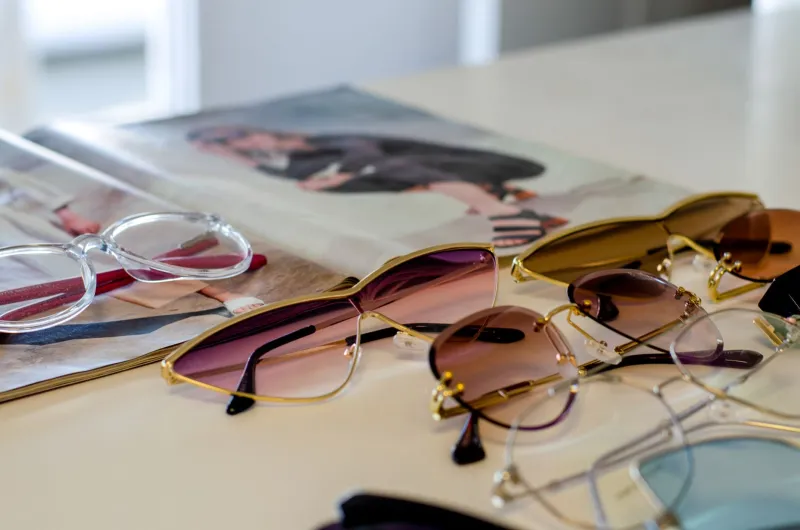
Before you evaluate a single frame, pull everything out. Every pair. Every case. Every random spare in the car, the gym bag, the office desk. Lay them all out on a clean, well-lit surface — natural light works best for spotting scratches, coating issues, and true color accuracy.
This full-collection view is often the first wake-up call. Most people genuinely don't know how many pairs they own until they're all in one place. Don't panic. That's what we're here to fix.
Have a few zones ready: Keep, Let Go, and Needs Attention. That third category is important — it's the holding zone for frames that have potential but need a repair, a new lens, or a deeper think before they earn a permanent spot.
Criterion #1: Wear Frequency
Be honest here. When did you last wear this pair? Not "when could I imagine wearing them" — when did you actually put them on your face?
If you can't remember, that's your answer. Frames that haven't been worn in six months or more are strong candidates for the Let Go pile, unless there's a very specific seasonal reason (dedicated ski goggles or beach sunglasses, for example).
If you track this kind of thing in a planner or phone calendar, even better. But most of us know intuitively which frames we gravitate toward and which ones collect dust.
Criterion #2: Style Versatility
A pair of frames earns its place in your collection by being able to show up in more than one context. Can these glasses work with your work outfits and your weekend look? Can these sunglasses go from a farmers market run to a rooftop happy hour?
One-trick-pony frames — pieces that only work with a single outfit or occasion you rarely have — are prime candidates for editing out. That doesn't mean you can never own a statement pair. But a statement pair should still be one you actually reach for, not one that intimidates you back into your safe default every single time.
Criterion #3: Physical Condition
Now look closely. We're talking scratched lenses, warped frames, loose hinges, missing nose pads, faded coatings, and any structural issues that affect how they sit on your face.
Some of these are fixable — and that's what the Needs Attention pile is for. A quick trip to your optician can often restore a solid frame for minimal cost. But if the damage is significant, if the cost to repair approaches the cost to replace, or if the frames are simply worn out, it's okay to let them go.
Keeping broken or uncomfortable frames "just in case" rarely pays off. They end up staying broken, taking up space, and making your whole collection feel messier than it is.
Criterion #4: Duplicate Styles
This one stings a little. Open your Keep pile and look for patterns. Do you have three pairs of thin metal rectangles in slightly different colors? Four tortoiseshell rounds that, honestly, look almost identical from five feet away?
Duplication happens gradually and usually without intention. You find a shape you love, you buy it again in a different colorway, then again when you see it on sale. Before long, you have a collection that technically has variety but functionally doesn't.
For duplicate styles, keep your absolute favorite — the one with the best fit, the best condition, the most wearable color — and let the others go. You'll wear the one you love more often, and your storage will breathe again.
Criterion #5: Prescription Accuracy
This applies specifically to your optical frames. Are you still wearing the right prescription, or are you hanging onto pairs from a previous script out of habit or nostalgia?
Outdated prescriptions don't just mean blurry vision — they can cause eye strain, headaches, and fatigue. If you've had a recent prescription update and haven't transitioned your everyday frames to reflect it, now is the time to make that call.
Old-prescription frames can sometimes be reglazed with updated lenses if the frame is still in great shape. If not, let them go.
What to Do With What You're Letting Go
Frames that leave your collection don't have to go in the trash. A few better options:
- Donate gently used frames to organizations like New Eyes or Lions Club, which distribute glasses to people in need across the US.
- Sell higher-end or designer frames through platforms like eBay, Poshmark, or Facebook Marketplace.
- Gift them to a friend or family member who might actually wear them.
- Recycle frames that are too worn to pass on — many optical retailers and LensCrafters locations accept old eyewear for recycling programs.
Build Your Audit Checklist
To make this process repeatable, use a simple checklist each time you do your seasonal audit. Here's what to run through for every single pair:
- Worn in the last 6 months? (Yes / No)
- Works with at least 3 outfits or occasions? (Yes / No)
- Lenses scratch-free and coating intact? (Yes / No)
- Frame structure solid — hinges, nose pads, temples all functional? (Yes / No)
- Prescription current (for optical frames)? (Yes / No / N/A)
- Does a near-identical pair already exist in my Keep pile? (Yes / No)
- Would I buy this again today? (Yes / No)
If you answer "No" to three or more of those questions, that pair is almost certainly a Let Go. Save this checklist to your phone or print it out and tape it inside your glasses storage drawer so it's ready every time audit season rolls around.
The Payoff Is More Than You'd Think
Once you've finished your audit, something interesting happens. Your remaining collection suddenly feels curated rather than accumulated. You can see exactly what you have, find what you need in seconds, and — maybe most importantly — identify the genuine gaps.
Maybe you realize you don't actually own a solid pair of everyday readers. Maybe your sunglasses are all statement styles and you're missing a reliable neutral. The audit doesn't just clear space — it tells you what your next intentional purchase should be.
That's the difference between a collection that just exists and one that actually works for you.