Old Glasses, Big Decisions: What to Keep, Donate, Sell, or Toss When Prescriptions Stack Up
Photo: Quinten Metsys, Public domain, via Wikimedia Commons
There's a good chance you know exactly where they are. That drawer in the bedroom. The shoebox on the closet shelf. Maybe a zip-lock bag tucked into a suitcase pocket "just in case." Old glasses have a way of accumulating quietly — one prescription change at a time — until suddenly you're sitting on a small museum of your own vision history and wondering what on earth to do with all of it.
You're not a hoarder. You're just someone who paid a lot of money for those frames, felt something when you wore them, and couldn't quite bring yourself to toss them in the trash. That's completely understandable. But at some point, the pile becomes clutter, and clutter has a cost — not just in drawer space, but in the mental overhead of managing a collection that no longer serves you.
Let's actually deal with this.
Why We Hold On (And Why It Makes Total Sense)
Prescription glasses aren't like old shoes. They were chosen carefully, fit to your face, and often tied to a specific chapter of your life. The chunky tortoiseshell frames you wore through grad school. The rimless pair from your first big job. The progressives you finally broke down and got at 45. There's history in those hinges.
Beyond sentiment, there's a very rational fear driving the pile-up: what if you need them? A broken pair, a lost pair, a scratched lens — any of these could leave you temporarily without vision correction. Keeping an old prescription around feels like insurance. And sometimes, it actually is.
But here's the honest truth: most of those backup pairs are never touched. They sit in the dark, lenses fogging, hinges stiffening, and coatings slowly degrading — while newer, better options go unused because the drawer is too full to find anything quickly.
Step One: Sort Before You Decide
Before you do anything else, pull everything out. All of it. Line the frames up on a flat surface and take stock. You're looking for a few things:
- Prescription currency: Is the Rx within one or two steps of your current prescription? If yes, these might genuinely function as emergency backups. If they're more than two prescriptions out of date, they're unlikely to help in a real pinch — and wearing the wrong prescription can cause headaches and eye strain.
- Frame condition: Scratched lenses, bent frames, missing nose pads, and cracked temples are all red flags. A frame that needs $80 in repairs before it's wearable again isn't really a backup — it's a project.
- Style viability: Trends cycle, but not always back to where you started. Be honest about whether you'd actually wear these if your current pair broke tomorrow.
Once you've sorted, you'll likely end up with three piles: keep (genuine backups), rehome (good frames, wrong prescription), and toss (damaged beyond reasonable use).
The Donation Route: Where Old Frames Do Real Good
For frames that are in decent shape but no longer useful to you, donation is one of the most genuinely impactful options available. Organizations like Lions Club International run one of the largest eyeglass recycling programs in the country — drop boxes are located at LensCrafters, Sears Optical, Target Optical, and hundreds of independent optometrists nationwide. The frames are cleaned, sorted, and distributed to people in underserved communities who need vision correction and can't afford it.
New Eyes is another US-based nonprofit that accepts both used glasses and gift cards to optical retailers. They serve individuals domestically and internationally.
One thing worth knowing: donated glasses with outdated prescriptions are still useful. Many programs re-lens donated frames or match them to recipients whose vision happens to align with the existing prescription. Your 2017 Rx might be exactly right for someone else in 2024.
Tax angle: Donations to qualifying nonprofits are generally deductible if you itemize. The IRS values donated eyeglasses at fair market value — typically $5 to $50 per pair depending on condition and brand. Get a receipt from the organization and keep a photo of what you donated. It's not a windfall, but it's something.
The Resale Market: Vintage Frames Are Having a Moment
Here's the part most people don't expect: old frames can actually sell. Not all of them, and not for a lot — but the vintage eyewear market is real, and it's growing.
Frames from the 1970s through the 1990s in particular are sought after on platforms like eBay, Poshmark, Depop, and specialty sites like eyeglassesvintage.com. Thick acetate frames, unusual geometric shapes, and discontinued designer styles from brands like Persol, Oliver Peoples, or vintage Bausch & Lomb can fetch anywhere from $20 to several hundred dollars depending on condition and rarity.
The catch: lenses usually need to come out for resale (buyers want to re-lens them to their own prescription), and condition matters enormously. Deep scratches, warped frames, or broken hinges will kill a sale. But if you've got a pair of well-preserved frames from a recognizable brand sitting in that drawer, it's worth a quick search on eBay to see what comparable pairs are selling for.
When Upcycling Makes Sense
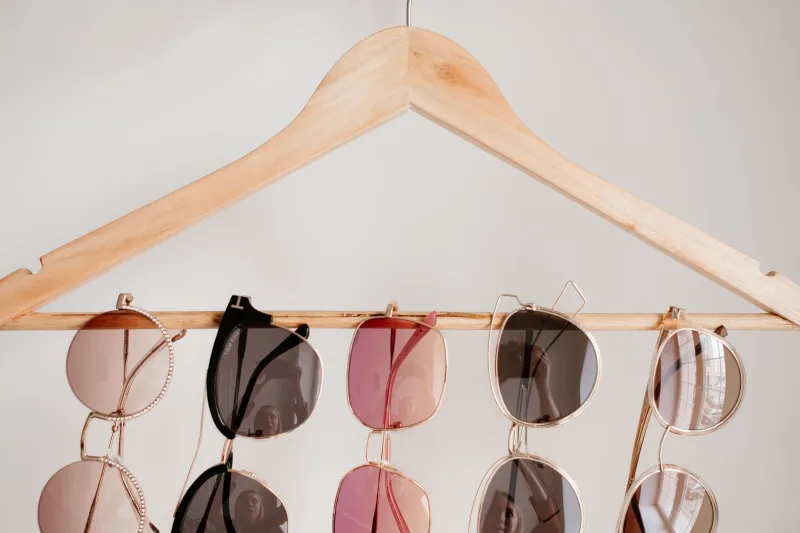
Not every old frame needs to leave your home in a functional state. Frames with sentimental value but no practical use can be repurposed in genuinely cool ways. Remove the lenses and use the frames as part of a shelfie display or gallery wall. Use them as a prop in a home office photo setup. Some crafters use old frames as decorative elements in shadowboxes or memory displays.
This isn't for everyone, but if the idea of tossing a pair feels wrong and the frame still holds meaning, finding it a decorative second life is a legitimate option.
What to Actually Toss
Some frames just need to go, and being honest about this is part of good collection hygiene. Heavily scratched lenses, frames with cracked acetate that can't be repaired, missing components that would cost more to replace than the frame is worth — these aren't worth donating (most programs won't accept them) and aren't worth selling. They belong in the trash, and that's okay.
Clearing them out makes room — physically and mentally — for the frames you actually love and use.
The Backup Pair Rule
Once you've worked through the pile, consider establishing a simple rule going forward: keep a maximum of one backup pair at any given time. When your prescription changes, evaluate whether the outgoing pair is recent enough and in good enough condition to serve as a backup. If yes, it earns the one backup slot. If not, it goes directly to a donation drop box before the new pair even arrives home.
This isn't about being rigid. It's about keeping the system manageable so that the drawer never becomes a museum again.