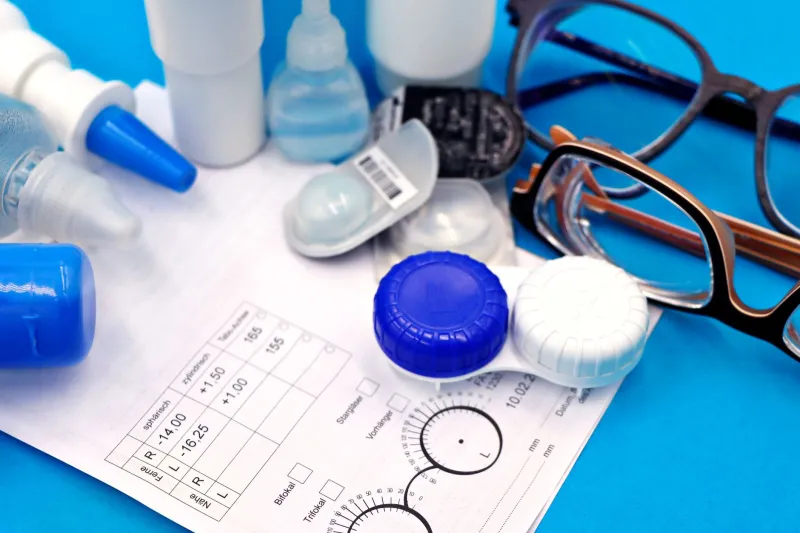
Glasses Gone Missing? Here's What That Chaos Is Quietly Costing You
Let's be honest: most of us have done it. You tear apart the couch cushions, check every surface in the kitchen, and eventually surrender to wearing your backup pair — the ones with the slightly wrong prescription — for an entire workday. It's annoying. It's stressful. But here's the part nobody really talks about: it's also expensive.
Disorganized eyewear isn't just a lifestyle inconvenience. It's a slow financial leak that can add up to hundreds of dollars a year, sometimes more. And the worst part? Most people don't even realize it's happening until they're staring at a credit card statement wondering where all their money went.
Let's break it down.
The Replacement Trap
One of the most common (and costly) side effects of eyewear chaos is the unnecessary replacement. You can't find your everyday glasses, so you assume they're lost or broken. You head to the optician, shell out anywhere from $150 to $500 for a new pair, and then — of course — find the originals stuffed inside a coat pocket three days later.
This happens more than people care to admit. According to the Vision Council, Americans spend over $40 billion on eyewear annually, and a meaningful chunk of that is driven by replacement purchases that didn't need to happen. When your frames don't have a designated home, "lost" becomes a much more expensive word than it should be.
A simple storage system — even just a dedicated tray or a multi-slot organizer on your dresser — gives every pair a home base. When frames always return to the same spot, "lost" stops being part of your vocabulary.
Duplicate Prescriptions and Rushed Eye Exams
Here's a scenario that plays out in optometrists' offices across the country: someone comes in convinced they need a new prescription because their current glasses feel off. But those glasses feel off because they've been sitting in a hot car, or they've been bent from being tossed into a bag without a case, or they've been cleaned with paper towels so many times the lenses are scratched beyond comfort.
The glasses aren't wrong. They're just damaged from poor storage.
A full eye exam runs $100 to $250 without insurance, and if you're walking in thinking you need new lenses when you actually just need a proper storage routine, that's money straight out of your pocket. Organized, well-protected frames stay in better shape longer — which means fewer "is my prescription still right?" spirals and fewer unnecessary appointments.
Missing the Insurance Window
Most vision insurance plans in the US reset on a calendar year or anniversary basis, offering allowances for frames, lenses, or both. But if you're not keeping track of what you own — and when you bought it — it's surprisingly easy to let those benefits lapse unused.
When your collection is a jumble of cases stuffed in drawers and frames scattered across multiple rooms, it's hard to do a quick mental inventory. You might assume you're fine, skip using your benefit, and then realize in January that the window closed. That's a real dollar amount you left on the table.
A simple catalog — even a note in your phone listing each pair, the purchase date, and where you bought it — makes it easy to know exactly when to take advantage of your coverage. Some eyewear enthusiasts go a step further and use a small notebook or a spreadsheet to track their collection like a financial asset, because honestly, that's what it is.
The Impulse Buy Spiral
There's a particular kind of shopping that happens when you're frustrated. You can't find your sunglasses before a weekend road trip, so you grab a cheap pair at a gas station. You lose your blue-light glasses at the office, so you order a random replacement on Amazon at midnight. These purchases feel small in the moment — $15 here, $30 there — but they compound fast.
What's more, they rarely satisfy. Gas station sunglasses don't offer real UV protection. Rushed online buys often don't fit right. So you end up with a pile of mediocre frames you don't actually like, while your original quality pair is probably wedged behind a nightstand.
Organization breaks this cycle. When you can see your entire collection at a glance — whether that's a wall-mounted display, a tiered organizer, or a dedicated drawer insert — you stop buying out of panic and start making intentional choices. You know what you have. You know where it is. And you stop paying the "I can't find it" tax.
Lens Damage from Improper Storage
Lenses are the most expensive part of any glasses purchase, and they're also the most vulnerable. Anti-reflective coatings, photochromic treatments, progressive lens grinding — these aren't cheap, and they don't hold up well to careless storage.
Frames tossed face-down on countertops. Lenses pressing against keys in a purse. Sunglasses left on a dashboard in August heat. All of these are storage failures, and they all shorten the lifespan of your eyewear significantly.
Replacing lenses alone can run $100 to $400 depending on your prescription and the coatings you need. A proper case — hard-shell for everyday carry, a soft pouch for backup — costs a fraction of that and can extend the life of your lenses by years. That's not a small return on investment.
What Good Organization Actually Saves You
Let's put some rough numbers together. If disorganized eyewear leads to even one unnecessary replacement per year ($200), one lapsed insurance benefit ($150 allowance unused), and a handful of impulse purchases ($60), you're looking at over $400 gone. And that's a conservative estimate.
Flip that around. A quality eyewear organizer — the kind that gives every pair a labeled, protected slot — might run you $30 to $80. A hard case for daily carry is another $15 to $25. A five-minute cataloging session costs nothing but time. The math is not subtle.
Beyond the dollars, there's also the mental load to consider. The low-grade stress of never knowing where your glasses are, the rushed mornings, the frustrated searches — that has a wellness cost too, even if it doesn't show up on a bank statement.
Start Small, Save Big
You don't need to overhaul your entire home to fix this. Start with one change: pick a single spot where glasses always live when they're not on your face. A small tray on the nightstand, a hook by the front door, a dedicated compartment in your bag. Just one consistent home base makes a measurable difference.
From there, build out. Add a case for every pair you carry regularly. Do a quick inventory of what you own. Check your vision insurance renewal date and put it in your calendar. These aren't big asks — but the savings they generate are very real.
Your frames are an investment. It's time to treat them like one.